March 19, 2012

PORTRAIT OF THE ARTIST AS A YOUNG MAN


How does the quality of our choices affect the quality of our lives? How does our view of the world change? What Creates Man's World View? 


How does the quality of our choices affect the quality of our lives? How does our view of the world change?

To say the least, Portrait of the Artist as a Young Man by James Joyce has quickly become one of my favorite novels of the semester, and one of my favorite books of all time. Not only is there an incredible level of depth in Joyce’s work, but there is a power of description that flows through the entire novel. There are segments of this novel that have left images and impressions on my mind that will certainly stay with me for years to come.

Portrait, in many ways, is one of the best studies to answer my big question that we have read throughout the semester. As the novel progresses, the reader is given an intensely detailed look into the past of Stephen Daedalus, the novel’s protagonist. As a child, Stephen is highly influenced by those that surround him – the political views of his father, his interactions with his schoolmates, and in particular the religious views of his mother and Dante, his aunt.

Religion quickly becomes a central focus of Stephen’s worldview, and an aspect that becomes the litmus test on his path towards adulthood. As a young boy enrolled in Clongowes, a Catholic boy’s preparatory school, Stephen has a simplistic yet conflicted view of the Catholic Church. On one hand, Stephen is enamored with the church – comparing Eileen, a young Protestant friend, to the Virgin Mary, and fearing the “terrible sin” of stealing the monstrance from the Church. Yet this characterization is coupled with the harsh practices of his Jesuit teachers, and on one occasion when Stephen is reprimanded and caned without cause, Stephen speaks out against the injustice, earning the respect of his peers and the smirks of his instructors.

This occasion appears to drive Stephen away from the Church for a time, in which Stephen begins a hedonistic journey into the world of prostitutes and sex. During this period, Stephen falls away from everything; he forgets his friends, his family, and almost entirely forgets the Church. Stephen continues pursuing the desires of his flesh until he attends a scathing sermon on the nature of Death, Judgment, Hell, and Heaven.   This sermon brings about a fearful change in Stephen, and “weep[ing] for the innocence he had lost” he turns from his ways, confesses to a priest, and begins a life of pious prayer and introspection. This life, however, leaves Stephen even further isolated from those he cares about, giving his soul with a sense of “spiritual dryness together with the growth of doubts and scruples.”

This doubt provides the grounds for the intense change in Stephen in the final chapters of Joyce’s novel. As Stephen nears the end of his school years, he is asked by the head of his school to consider joining the priesthood. Although he contemplates this path, in the end, Stephen recalls his days as a child at Clongowes, as well as his years of hedonism and years of piety, and chooses a middle path. Stephen rejects a direct role in the Church, and instead pursues life as an artist. His past – in particular his past relations with the Church – gives way to a new life, and is described as “ the cerements shaken from the body of death...the linens of the grave.” Stephen breaks with his past and the church and continues in a new direction entirely.

This direction leads Stephen into the final stage of his manhood. After attending the university, Stephen has progressed immensely from the simple schoolboy Joyce relates at the beginning of the novel. This new Stephen, empowered by his art and his freedom from the world, issues one of the most powerful (and one of my personal favorite) statements of the novel:

I will tell you what I will do and what I will not do. I will not serve that in which I no longer believe, whether it call itself my home, my fatherland, or my church: and I will try to express myself in some mode of life or art as freely as I can and as wholly as I can, using for my defense the only arms I allow myself to use, silence, exile, and cunning.

Stephen, in a sense, creates his own religion by the end of the novel. No longer bound by the stigma of society, nor the judgment or support of his family and peers, Stephen pursues that which gives him meaning and purpose. Stephen’s rejection of organized religion and the Catholic Church marks the beginning of his adulthood, a young man on a mission to change the world and the way we live in it.

To some extent, I think that Joyce has done exactly this. Although I don’t necessarily agree with his stance on Christianity or other major topics of the novel, I am inspired by Stephen’s dedication to that which gives him meaning. In spite of all difficulties, Stephen remains true to his art, a determination and drive that we all must have in our lives, whether we are a young man striving towards the artistic ideal, or a young man writing a blog post for his Literature class. And, as one who has some experience in both, it appears to me that determination and perseverance are the most important step on this path to purpose and meaning. 


February 22, 2012

BELOVED

How does the quality of our choices affect the quality of our lives? How does our view of the world change?


To say the least, Toni Morrison’s novel Beloved is anything but beloved in my mind. I think that the magical realism Morrison utilizes goes too far, leaving me (particularly as a male reader) unsettled and uncomfortable. Although Morrison’s description and style are powerful, there is just too much in this book – it, like the love of its main character, is “too thick”.

However, despite my personal distaste for the novel, it is certainly a work of literary merit, and one that fits quite well with my big question. I think that the novel exists as a study of the past – of the choices Morrison’s characters have made – and how these characters cope with the harsh reality of their former lives as slaves. Each character has a different approach to dealing with the past – some that are healthier than others, and some that are certainly detrimental.

One character’s past that is particularly painful is that of Sethe. Forced to choose between life as a slave and death, Sethe attempts to murder her children in order to save them, killing one of her daughters, and managing only to maim her other three children. Sethe’s choice to kill her daughter, known only as ‘Beloved’, haunts her throughout the novel, both in her emotional and social state, but also in physical form, when Beloved returns in the form of an adult woman. Although Sethe is consistently advised to “lay down her sword and shield” and the pain of the past, Sethe clings to it, searching for forgiveness and peace, yet only finding pain and suffering.

Like Sethe, her daughter – and only remaining child – Denver, is a victim of her mother’s past. Early in the novel, Denver is totally dependent on her mother, childlike to a level that distracts from the fact that she is indeed a young woman. To Denver, Beloved is her only friend; however, as Beloved grows more and more powerful in the household, Denver begins to come to terms with herself. She must venture out into the world in order to save herself and her mother, and she does so, moving forward from the decisions and fear of the past, and taking control of her future.

It is this same path that Paul D takes. Paul D has a history almost as painful as Sethe’s – a story of dehumanization, escape, and drifting that leads him to question not only people, but his own manhood, another struggle integral to the novel. Paul D arrives at 124 with his story locked up in “the rusty tobacco tin of his heart”, yet as he spends time with Sethe, Paul D begins to come to grips with his past. Although he leaves when he learns of Sethe’s past crimes, Paul D returns to 124, and in the very end of the novel, Paul D is a changed man, one with friends, family, and a future.

Although I am not a fan of Morrison’s novel, I do agree to some extent with her characterization of the past. We cannot let the past control us, and if necessary, we must “beat back the past” in order to earn the future – as Morrison writes, “The future was sunset; the past something to leave behind. And if it didn’t stay behind, well, you might have to stomp it out. Slave life; freed life – every day was a test and a trial.” If we let the past control our lives, then we become nothing but ghosts in the present. Life in fear is no life at all, and our challenge is to move past this fear into bigger and better pursuits. 

January 22, 2012

THE STRANGER

WHAT CREATES MAN'S WORLDVIEW?

The worldview held by Meursault in Albert Caumus’ The Stranger is aptly one of the strangest ways of life that I have read all semester – quite the feat when one of my novels, The Road, describes the lives of a father and son traveling through a post-apocalyptic wasteland.

Early in the novel, Meursault appears to view and react to life apathetically, making no real decisions and having no real emotions, even over the death of his own mother. This path defines Meursault for nearly the first half of the novel, and even the climax of the story, Meursault’s murder of the Arab, appears an empty and meaningless act, undertaken almost nonchalantly – and certainly without remorse.

But as Meursault is tried for his crimes in the second half of the novel, Camus begins to reveal an entirely different side of Meursault.  To say a change comes over Meursault I think would be false; instead, the second half of the novel provides some insight into the motivations and the inner workings. No longer does Meursault appear the careless perpetrator of a murderer, but a helpless man – controlled by a social machine and pushed to his destruction by a harsh universe. Meursault does nothing because he has no power to do anything else; he is a spectator to an absurd game that determines his fate. This change in depiction, at least for me, although far from making me like Meursault or his actions, led me to feel a sense of pity for his condition, and somewhat distraught over the apparent injustice of the situation.

Despite this change of opinion, Meursault’s fate is sealed; Meursault’s acceptance of this fact in the final chapter provides some of the most powerful moments of the novel. One line that particularly stuck out to me was when, remarking on his imminent execution, Meursault states, “Deep down, I knew perfectly well that it doesn’t matter whether you die at thirty or seventy – whether it was now or twenty years from now, I would still be the one dying.”  Although there are doctrines of existentialism and thoughts that Camus relates that I strongly disagree with, this quote resonates with me. A sense of carpe diem gives this dismal section a somewhat hopeful air, and Meursault’s acceptance of this grim reality gives him a freedom that cannot be conquered even in death.

I think that this is where the power of The Stranger lies. Although I don’t necessarily agree with existentialism, this book is interesting and compelling, and makes a fascinating argument for the existentialist world view.

December 13, 2011

Crime and Punishment

WHAT CREATES MAN'S WORLDVIEW?

I think that Crime and Punishment has had the most support for this question of any novel the class has read thus far. Not only does Dostoyevsky create a world with complex characters, but the entire novel surrounds the question of ‘Why does Raskolnikov kill the Pawnbroker?’, a question that I think is answered primarily through how Raskolnikov sees the world.

At the beginning of the novel, Raskolnikov relates how he sees his place in the world – he sees himself as a genius, a man to whom anything can be granted. Raskolnikov believes that through the murder and robbery of the Pawnbroker, he can better not only his position in life but also better society. Raskolnikov undertakes his plot, and sets the novel in motion.

After the murder, Raskolnikov undergoes a change – he feels guilt and remorse over the murder of the old woman, and the unfortunate (but apparently necessary) murder of Lizaveta, the sister of the Pawnbroker. This guilt, along with a reunion with his family and a friend from the University, eventually lead Raskolnikov to change his view of himself and the world – Raskolnikov begins to believe that he is not a ‘Napoleon’ like he once believed, a thought that brings him closer and closer to his confession.

But Raskolnikov does not change his view of the world overnight. Even in the latter stages of the novel, Raskolnikov continually refers the Pawnbroker as a ‘louse’, and his torment between his capabilities and his reality leads him through stages of inaction, despair, and hatred not only for his family and friends, but eventually for himself.

In the midst of this torment, Raskolnikov grows closer and closer to Sonia, the prostitute-daughter of a drunkard Raskolnikov once met in a tavern. Almost inexplicably, Raskolnikov becomes further and further entwined with Sonia’s family, paying the debts caused by her father, and eventually for his funeral. Raskolnikov even steps in to avoid her honor when it is challenged by Luzihn, a shifty lawyer who has designs on Raskolnikov’s sister.

This closeness eventually comes to a head when Raskolnikov confesses his crime to Sonia. With her support, and promise to follow him to prison in Siberia, Raskolnikov eventually turns himself in to the authorities, and is sent to prison to suffer for his crimes.

Yet not even in prison does Raskolnikov change his view of the world. It is only after a year in prison, another illness, and the ‘fresh air’ of Siberia that Raskolnikov comes to his senses – “Life began to replace theory,” and Raskolnikov realizes that there is more to life; he falls in love with Sonia, returns to his faith, and the novel ends with great catharsis, knowing that Raskolnikov’s focus is no longer on himself, but on bigger and better pursuits.

October 24, 2011

King Lear

What Creates Man's World View?

One of the questions I’ve had throughout Lear has been “Why do Goneril and Reagan so quickly turn against Lear?” At the opening of the play it appears that they should be utterly grateful – not only has Lear granted them their wildest desires – immediate shares in Lear’s kingdom and it turn his fortune – but in his rash decision against Cordelia both sisters receive an extra portion than what Lear originally intends. And despite the difficulties of housing Lear and his rowdy one hundred knights, this dispute does not seem grounds for his daughters to disown, deface, and eventually bring death to Lear.

To answer this question, I think we need to take a look at the way the two sisters view the world, and in turn where this view comes from. In the same scene that Goneril and Regan receive their portions of the kingdom, Shakespeare reveals an important truth about Lear. Lear’s question to his daughters is not “Do you love me?” or “Why do you love me?” but instead is “How much do you love me?”. This exposes how Lear quantifies love – he doesn’t recognize affection and immeasurable emotion, and indeed punishes Cordelia, his only faithful daughter, for her inability to “heave her heart into her mouth”. Lear’s daughters receive their inheritance not out of merit but on flattery; more kind words in Lear’s mind is the same as more love, and he eagerly tries to attain both of these things.

This same view of the world – and the quantification of love – appears to be echoed by Regan and Goneril. The two daughters are happy to please Lear while he has power, and something to offer them – Lear’s gifts of land are the ultimate act of love in their eyes. Once Lear relinquishes this power, he loses his ability to show his daughters love in a way that they eagerly recognize. It is no longer important to the two sisters that Lear is their father; his lack of land and influence appear to be a lack of love. This point of view, when combined with the nuisance Lear and his knights are to his daughters, combine to change their opinion of Lear in terrible ways.

This quantified view of the world continues throughout the play in nearly every act the sisters undertake – be it their dismissal of Lear’s entourage, the accusations of treachery that finds Gloucester, or the two sister’s battle over the affections of Edmund the Bastard – each action the sisters undertake is an attempt to solidify their power and bring them quantifiable success and greatness.

It is this terrible mode of conduct that Shakespeare writes against – the greed, the lust, and the quantification of love these sisters (and even Lear) depict are dangerous, and cause disorder not only in the family but in the world, a theme dominantly established in Lear, and an outcome feared by Shakespeare and all others of the Elizabethan worldview.  


This picture in my mind sums up the actions of Lear's daughters -- just as the man in this picture appears to be swallowed up and drowned in his money, Goneril and Reagan set themselves on a path towards their ultimate destruction, a destrcuction not caused by outside forces but instead caused directly by their greedy actions. The sister's usurpation of their father, destruciton of their friends and family, and the downfall of their kingdom all can be traced back to their greed and their quantification of love.


September 15, 2011

Oedipus the King

WHAT CREATES MAN’S WORLD VIEW?
Oedipus view of the world appears defined by the time the play begins. The mystery of his birth, and the constant questioning of the people of Corinth have led him to question the world, and to seek out the truth in it. He has come from a foreign land, trying to escape a terrible prophecy, and has found fortune; by solving the riddle of the Sphinx he becomes King of Thebes. Oedipus sees the world as under his control – he believes he has escaped the oracle’s prophecy and has made a way for himself in the world – and also believes that he can find truth in the world. It is exactly these two facets of his worldview that determine Oedipus’ fate.
Throughout the play, Oedipus continually searches for King Laios’ murderer, and unknowingly brings himself closer to his doom with every new discovery.  Oedipus appears led to his fate more by how he sees the world – with answers to questions that can be solved without the help of the gods – than a tragic flaw of character. In effect Oedipus’ view of the world and the mysterious circumstances of his birth that led him to it are his tragic flaw, and bring about his doom.
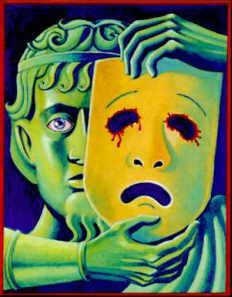
This picture shows both parts of Oedipus, the half that could have been as well as the half that existed. We see Oedipus as he saw himself before the play: A king, a husband, a father. But perhaps even more powerfully we see what Oedipus became: wretched, broken, and dismayed. This picture depicts the transition that exists during the play, and serves as a visual representation of Oedipus downfall -- it shows both sides of Oedipus instead of focusing solely on what would become.

August 31, 2011

"The BIG QUESTION"

To choose the moment of my life that sparked this question would be practically impossible. It may have been hearing the words of William Ernest Henley teaching me of the “unconquerable soul” and that I had the capability to become “the master of my fate” and “the captain of my soul”.

Or perhaps it was before then, while watching the movie Signs. In the midst of an alien invasion, Mel Gibson described to me how “People break down into two groups. When they experience something lucky, group number one sees it as more than luck, more than coincidence. They see it as a sign, evidence, that there is someone up there, watching out for them. Group number two sees it as just pure luck. Just a happy turn of chance. I'm sure the people in group number two are very suspicious. For them, the situation is a fifty-fifty. Could be bad, could be good. But deep down, they feel that whatever happens, they're on their own. And that fills them with fear. Yeah, there are those people. But there's a whole lot of people in group number one. When they see those fourteen lights, they're looking at a miracle. And deep down, they feel that whatever's going to happen, there will be someone there to help them. And that fills them with hope.”

I can’t be certain if one of these events directly spurred my question, or if it is a combination between these and all the other occurrences of my life. What I can be more certain of is that my ‘big question’ is this:

How does the quality of our choices affect the quality of our lives, and how does our view of the world – a world of Divine Inspiration and Fate, or a world of happenstance and luck – change in light of these decisions?

This question plays a large role in The Road by Cormac McCarthy. In this novel, a Man and his Son (who go unnamed throughout the entire novel) are the survivors of a mysterious disaster that has left the world literally in ashes. Faced with this ruined world, these two must bond together and make the best of their situation, constantly trying to remain the “good guys” and “carry the torch” amidst a post-apocalyptic backdrop.  In this case, both the Man and the Son appear to see the world through the lens of divine inspiration. In the Man’s case, this worldview has tainted his mind, and he bitterly walks through life, lamenting how “there are no godspoke men. They are gone and [he is] left and they have taken with them the world.” Contrastingly the Son has hope from this situation, and relies on his father and his viewpoint whole-heartedly. In both cases, the decisions that ultimately mean life and death for this father and son spur from this Divine world view, and they carry on their journey for better or for worse.

As this year progresses, I hope to come closer to answering this question, and to further define my question. But before I begin this journey, I will have to answer the question Mel Gibson posed to me in the same movie: “You have to ask yourself, what kind of person are you? Are you the kind that sees signs, that sees miracles? Or do you believe that people just get lucky? Or, look at the question this way: Is it possible that there are no coincidences?” It is the answer to this question that will determine my course of discovery, and even what I will find at the end of it.